
Gambling Affordability Checks in the UK – The 2026 Reality for Casino Players


Getting asked for a payslip mid-session feels like being treated like a suspect, but it’s not personal. In 2026, gambling affordability checks are a standard part of playing at any casino licensed in the UK. In this article, we break down exactly why these checks happen, what documents you’ll need, and how to get through the process without stress or delay.
The New Casino Standard
An affordability check, also called a financial risk check, is a review that online casinos conduct to confirm that players can comfortably afford what they’re spending.
The core rule regarding UKGC financial checks is much milder than it might sound. Since 28 February 2025, the UK Gambling Commission has required every licensed operator to run a light-touch financial vulnerability check. The casino’s system runs this check quietly in the background against public records, so you will never notice it or be asked to submit any documents.
Since early 2026, reviews of gambling affordability checks have moved from something only cautious operators bothered with to a baseline built into how every UK-licensed site now works. That is why a message asking for a payslip isn’t a red flag on your account: it’s simply how operators meet their obligations of conducting affordability checks imposed by the Gambling Commission.
As you see, these requests by the casino aren’t arbitrary. And some specific actions on your account may set the review process in motion.
The Moments That Trigger a Financial Review
Casinos don’t ask for financial documents at random. A review is typically triggered by one of the following:
- Deposit or spend threshold excess. The background vulnerability check is automatic – it’s run by the casino operator’s own system, quietly in the background against public records. You won’t be asked to provide anything. Financial risk assessment sits far higher up. It goes in stages, and the first stage only kicks in once your spending climbs into a much higher bracket.
- Unusual behavioural pattern detection. A sudden spike in betting frequency, a run of rapid successive deposits, or a noticeable change in how you normally play can all prompt a closer look, even below the usual spend thresholds.
- Large withdrawals detection. If you’re cashing out a substantial win, the casino will typically double-check your identity and the source of your funds before releasing the payment.
Not every check feels the same from your side. Here’s when each is triggered and what it means for your account.
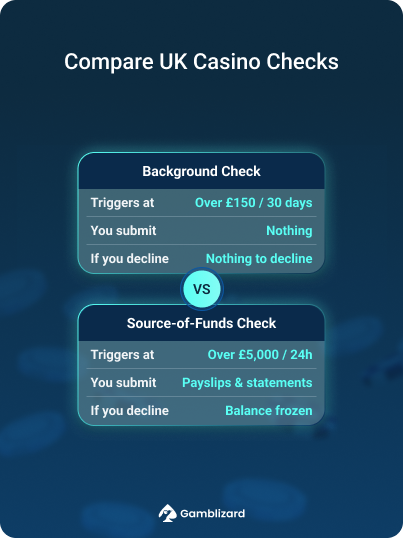
The under-25 threshold sits lower – a source-of-funds review can begin at around £2,500 in a rolling 24-hour period rather than £5,000. Both figures are only a starting point: each operator builds its own risk model on top of the UKGC minimum, so the same spending pattern may trigger a review on one site but not on another.
Identification of these baseline thresholds solves merely part of the puzzle, since strict anti-money laundering rules form the real reason casinos scrutinise personal finances.
The Real Reasons Casinos Ask for Payslips
If you’ve ever wondered why do gambling sites ask for bank statements, it comes down to three connected reasons:
Responsible Gambling Checks
Operators have a duty to make sure you are only ever spending disposable income – the money left over after bills, rent, and essentials, rather than funds you can’t genuinely afford to lose. Disposable income verifications are at the heart of responsible gambling and are among the easiest ways for operators to assess whether your spending habits are under control.
Anti-Money Laundering and Source of Funds Inspection
Casinos are legally required to confirm that your deposited money comes from a legitimate source, whether that’s a salary, self-employment earnings, or another verifiable stream.
This is where payslips and bank statements usually come in, which is separate from automatic affordability checks. It isn’t unique to gambling either, as banks and other regulated financial services in the UK run the same source-of-funds checks.
Licence Protection
British operators face heavy fines – and can lose their licence entirely – if they fail to carry out proper financial checks. For a casino, requesting your payslips and bank statements isn’t box-ticking; it’s a strict condition of holding a licence to operate in Britain.
Clear intentions behind document requests set a solid foundation, allowing you to prepare specific, acceptable financial records that ensure uninterrupted account verification.
Documents That Get You Through the Check Fast
Most casinos accept a fairly standard set of documents. Preparing them in advance will speed up your account checks and let your cashouts go smoothly:
- Payslips: Official wage slips covering the last 1–3 months are the most commonly requested proof of regular income.
- Bank statements: Full monthly statements that clearly show recurring salary or income deposits, rather than a single screenshot or a partial page.
- Alternative income sources: If you’re self-employed or freelance, tax returns or HMRC Self Assessment documents work in place of payslips. Proof of a property sale, an inheritance document, or dividend vouchers can also be accepted where relevant.
Submitting the correct document on your first try – whether at deposit or withdrawal – is the fastest way to pass gambling affordability checks in a UK account review.
Once your documents are with the operator, it’s natural to wonder what happens to that information afterwards.
Keeping Your Financial Details Safe and Private
It’s completely understandable to feel uncomfortable sharing your payslips and bank statements with a gambling website. Here’s how casinos actually handle and protect your sensitive data:
- Any documents you submit are processed under UK GDPR. While Anti-Money Laundering (AML) laws require operators to retain your records for 5 years after account closure, strict rules govern their eventual removal. Your IDs, proof of income, and selfies will be permanently deleted or anonymised across all casino servers, backup files, and third-party verification providers (like KYC tools).
- Your files aren’t visible to customer support staff or general employees. Access is limited to certified AML and compliance teams specifically trained to handle sensitive data.
- These checks have no impact on your credit score. A standard gambling affordability check on credit file records is what’s known as a “soft check.” It doesn’t appear on your credit report, so it has zero effect on your ability to get a mortgage, loan, or credit card.
Of course, you may refuse to forward your financial records to the casino. In such a case, you should be prepared to face certain limitations on the website of your choice.
The Consequences of Refusing to Verify Your Income
You can’t really refuse the automatic background check, as there is nothing for you to provide. Declining a source-of-funds or identity request is a different matter. It typically leads to one of the following outcomes:
- Account restrictions, under which casinos may temporarily suspend your activity or set deposit limits until you provide the required documents.
- Balance freeze. The operator will hold your existing funds and any withdrawal requests under anti-money laundering laws until it confirms your identity and the source of your funds. This is a legal obligation for the operator, not their whim.
The myth surrounding winnings is worth clearing up, too. Some players believe casinos use affordability checks as an excuse to dodge payouts. In reality, Gambling Commission affordability checks exist to protect players and enforce fair standards, not to withhold money that’s rightfully yours. Properly verified winnings are always paid.
This is why it works in your favour more to understand how UK gambling affordability checks work than to avoid them. You’ll get through the check smoothly the first time if you complete the next steps right.
Smart Ways to Pass Verification
A few simple habits make the entire process faster and far less stressful:
Redact Your Details Carefully
You can safely black out long card numbers or account numbers, but your name, the date, and the amounts should be clearly visible. Over-redacting a document is one of the most common reasons checks get delayed.
Submit Complete Files
Use high-resolution PDFs or clear photos that show all four corners of the document. Blurry or cropped images almost always bounce back for resubmission. It takes a few seconds to take a photo, but double-checking this can save days, even weeks, in the long run.
Set Your Limits Early
Setting a personal deposit limit from day one – well before you hit the operator’s financial check threshold – is one of the most effective ways to stay ahead of affordability checks for gambling. It helps you maintain control and keeps your spending in a comfortable, sustainable range.
Affordability checks aren’t designed to catch you out; they exist to make gambling in the UK safer for everyone. Play within what you can genuinely afford, and treat any document request as routine rather than something personal. If you ever feel a casino has handled your verification unfairly, leave us a comment below, and consider filing a formal complaint with the relevant regulatory authority.